
Steam Traps: The Hidden Losses in a Steam Network
How failed steam traps affect performance, reliability and operating costs.
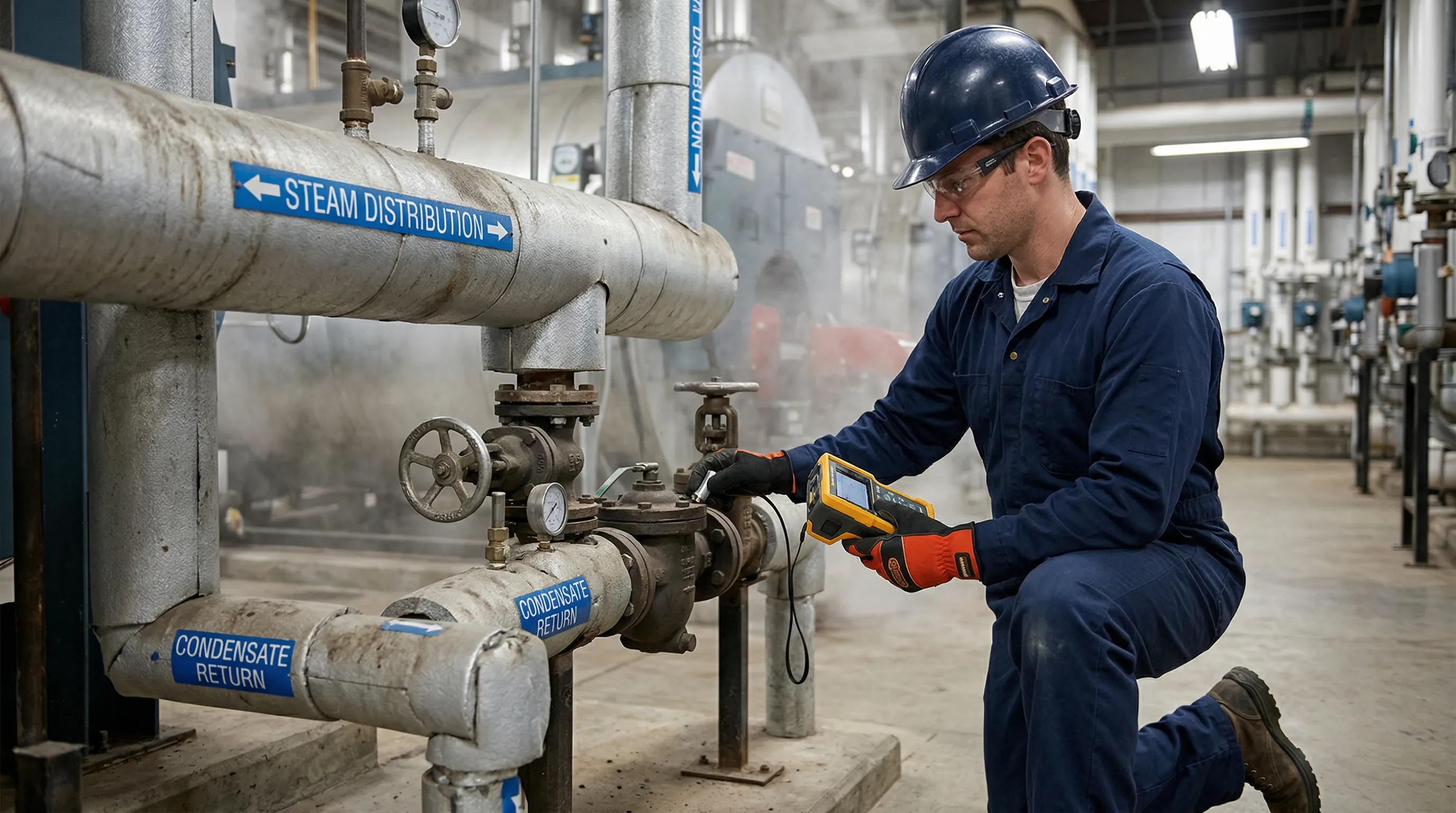
At a Glance
A failed steam trap can waste energy, disrupt heat transfer and increase instability across a steam network. A documented inspection program helps prioritize replacements and reduce losses that often remain invisible for too long.
Why Do Steam Traps Matter So Much in a Steam Network?
A steam trap has a simple purpose in principle: remove condensate and air without letting useful steam escape unnecessarily. In practice, it is a small but critical component. When it no longer performs as intended, the network can lose stability, efficiency and heat transfer capacity without the issue being immediately obvious on site.
What Kinds of Losses Can a Failed Steam Trap Create?
A trap stuck open can waste steam and drive up energy consumption. A trap stuck closed can hold back condensate, reduce heat transfer and disturb downstream equipment. In either case, the site usually pays several times over: in fuel, in lost performance, in service time and in added pressure on the maintenance team.
The scale of the problem is well documented. The U.S. Department of Energy reports that in steam systems left unmaintained for three to five years, 15% to 30% of installed steam traps may have failed, letting live steam escape into the condensate return system — while in systems covered by a regularly scheduled maintenance program, leaking traps should account for less than 5% of the trap population. That gap is not a theoretical figure: it is the exact margin a maintenance program either recovers or gives away.
Why Do These Losses Often Go Unnoticed?
Because a steam network can continue operating while it is slowly degrading. The building or process may still appear to be “working,” but with more energy, more instability and less operating margin. The warning signs are often indirect: underheated zones, poor condensate handling, temperature swings, occupant complaints or repeated gaps in performance that had previously been under control.
How Should Traps Be Tested, and How Often?
The Department of Energy lists four basic ways to test a steam trap: temperature, sound, visual inspection and electronic methods. The “sound” category is why the ultrasonic leak detector has become standard equipment in a boiler room — it distinguishes a trap cycling normally from one blowing through continuously, without shutting the process down. Natural Resources Canada makes a similar point: where no leak is visible or audible, check monthly using ultrasonic detectors, listening rods, pyrometers or stethoscopes.
For trap testing itself, the Department of Energy scales the interval to network pressure: weekly to monthly for high pressure (150 psig and above), monthly to quarterly for medium pressure (30 to 150 psig). The logic is straightforward — the higher the pressure, the faster a failure turns into real money, and the shorter the interval needs to be.
What Is the Best Way to Move Beyond Reactive Maintenance?
The best approach is to document the installed base, classify critical points and schedule inspections according to site priority. That makes it possible to target the steam traps that matter most, avoid random replacement and build a credible maintenance decision framework. On more sensitive sites, that discipline also helps plan shutdown windows more effectively and reduce emergency calls.
Official guidance converges on what such a program must contain. The Department of Energy recommends establishing regular, systematic inspection, testing and repair of steam traps, backed by a reporting mechanism that documents the energy and dollar savings achieved, and monitoring the traps tied to the most important processes on an ongoing basis. Natural Resources Canada adds two items that often get skipped: the program should include its own written procedures, and steam quality depends on chemical water treatment — a trap replaced on a network with uncontrolled water chemistry will simply degrade again. Comparing measured steam and condensate flows offers another simple check: when the two do not match, the condensate piping is where to look for leaks.
How Can Montréal Combustion Support This Type of Issue?
When a steam network plays an important role in operations, it deserves a structured review rather than isolated corrections. Montréal Combustion can support facilities across Greater Montréal, the Rive-Nord and the Rive-Sud by helping identify priorities, restore maintenance sequencing and connect field symptoms to larger boiler room, distribution and operating cost issues. The same documented decision logic applies further upstream, when the question becomes when to replace a commercial boiler rather than keep repairing it.
Frequently Asked Questions
How often should steam traps be checked?
Can a failed steam trap affect more than the energy bill?
Should all steam traps be replaced at once?
Sources
- Steam Tip Sheet #1 — Inspect and Repair Steam Traps — U.S. Department of Energy — Advanced Manufacturing Office
- Ensemble, économisons l'énergie! Les réseaux de tuyauterie de vapeur et de condensat — Natural Resources Canada — Office of Energy Efficiency