
Micromodulation and O2 Trim in the Boiler Room
What micromodulation and O2 trim can change in combustion stability and day-to-day operation.
At a Glance
Micromodulation and O2 trim can improve control precision in a boiler room, especially when loads fluctuate and combustion stability matters. Their value still depends on project quality, equipment condition and the site's ability to operate and maintain the upgraded system.
Why Do Older Mechanical Control Strategies Sometimes Reach Their Limits?
In a boiler room that has to follow varying loads, older linkages and control strategies can lose precision over time. That does not mean every older system is obsolete, but when a site starts seeing drift, recurring alarms or unstable combustion, control quality becomes an operating issue rather than simply an equipment issue.
What Does Micromodulation Actually Change?
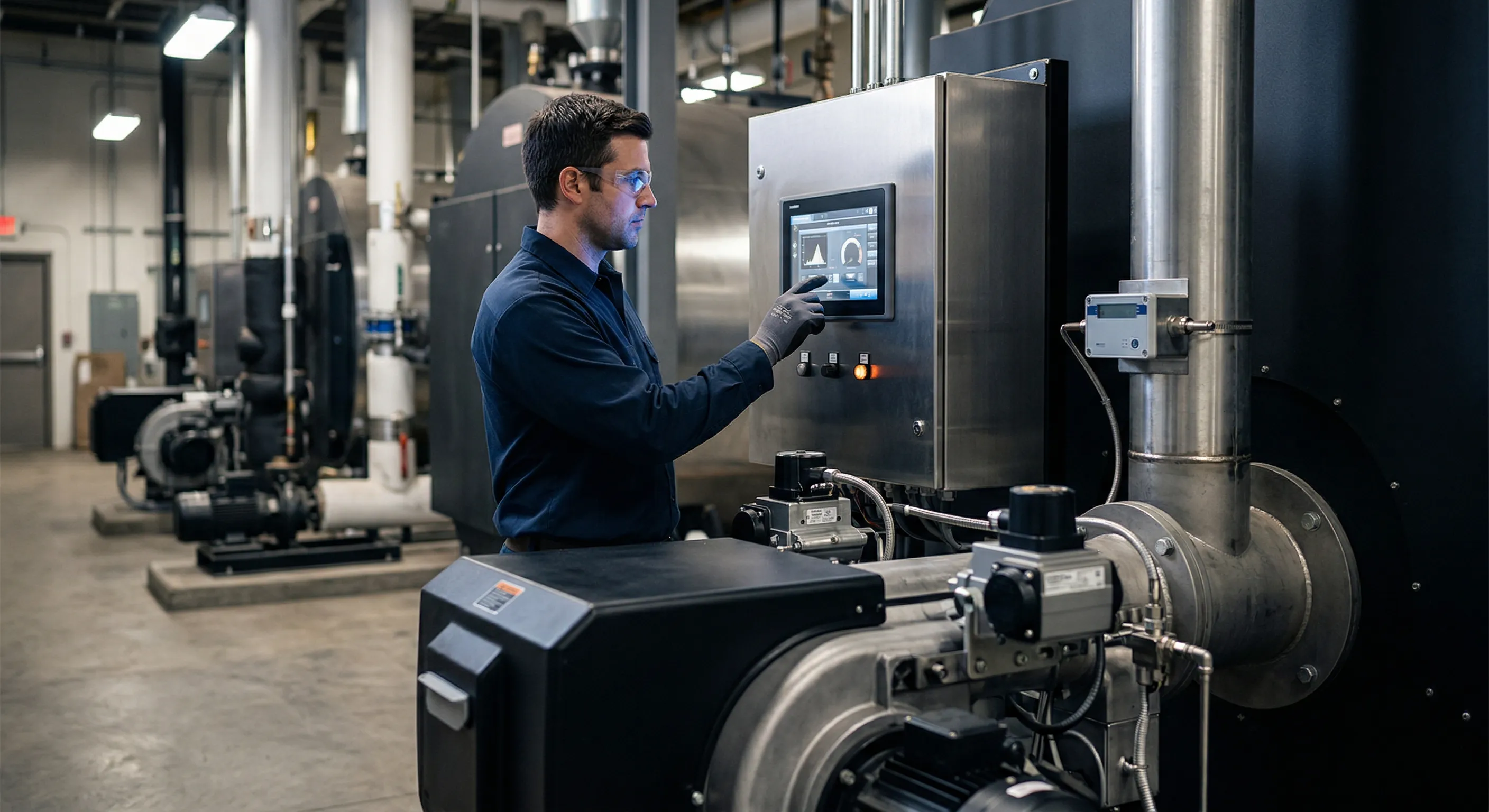
Micromodulation replaces a more rigid control approach with finer coordination of air and fuel. It can help track changing loads more accurately, reduce certain tuning drifts and make burner behavior more predictable. From an operations standpoint, the main value is not sophistication for its own sake, but stability: fewer deviations, fewer repeated adjustments and a clearer understanding of how the burner is behaving.
What Role Does O2 Trim Play in That Setting?
O2 trim adds a correction loop that helps keep combustion quality more stable as conditions change, holding excess air within a narrower band — a parameter that also influences nitrogen oxide (NOx) formation. Depending on the site, this can support steadier performance and more consistent operating margins. Its value still depends on installation quality, calibration, maintenance and the broader control strategy. O2 trim does not, by itself, solve the weaknesses of a poorly prepared boiler room. The U.S. Department of Energy’s STEAM tip sheets point the same way: they recommend online monitoring of flue gas oxygen, which surfaces tuning drift and certain control failures early — before they turn into service calls.
When Is This Kind of Modernization Worthwhile?
It becomes interesting when the site suffers from recurring imbalances, repeated service calls, tuning difficulties or declining confidence in the existing controls. On the other hand, if the core issue is weak preventive maintenance, fouling or an upstream defect, adding layers of control can make the system more complex without resolving the real cause. That is why modernization has to be sequenced after a clear reliability review. Once that groundwork is done, the same Department of Energy guidance offers a useful screening rule: excess oxygen above 3%, or weak combustion efficiency, justifies evaluating linkage-less electronic sensors and controls, an O2 trim system or a newer burner.
How Should a Project Like This Be Evaluated Without Overpromising?
The right approach is to review the operating history, observe actual boiler behavior and verify compatibility among the burner, actuators, sensors and control logic. The logic mirrors that of modernizing a boiler room without oversizing it: start from the actual load and the condition of the existing plant, not from a catalogue. Montréal Combustion can support that evaluation across Greater Montréal, the Rive-Nord and the Rive-Sud to determine whether micromodulation and O2 trim are real stability levers or whether other mechanical priorities should be addressed first.
Frequently Asked Questions
Is micromodulation useful on every boiler?
Is O2 trim only about emissions?
Can a boiler room be modernized without replacing everything?
Sources
- Steam Tip Sheet #4 — Improve Your Boiler's Combustion Efficiency — U.S. Department of Energy — Advanced Manufacturing Office
- Steam Tip Sheet #24 — Upgrade Boilers with Energy-Efficient Burners — U.S. Department of Energy — Advanced Manufacturing Office